


 How many people today grab a takeaway coffee cup from the local cafe to drink on the go? We don’t know, but the number must be enormous.. Most every one of the above have a plastic top that will last 100s of years. Some cafes still use plastic cups that last a similar time. Is 10 minutes of coffee worth 100s of years of trash?
These items can be seen littering our gutters and on our streets all over the place. If they were all cardboard, they would still be littered, but they would, at least, be gone in a short time.
They do not need to be made of plastic.
How many people today grab a takeaway coffee cup from the local cafe to drink on the go? We don’t know, but the number must be enormous.. Most every one of the above have a plastic top that will last 100s of years. Some cafes still use plastic cups that last a similar time. Is 10 minutes of coffee worth 100s of years of trash?
These items can be seen littering our gutters and on our streets all over the place. If they were all cardboard, they would still be littered, but they would, at least, be gone in a short time.
They do not need to be made of plastic.
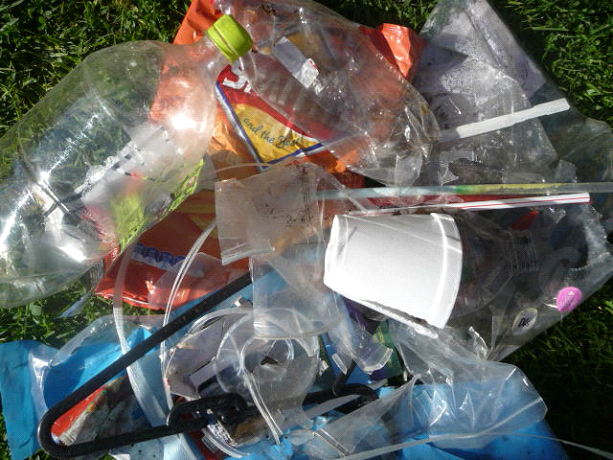 On the way home from the gym last week, a distance of about 1 km (1/2 mile), I counted the items of plastic litter on the curb as I walked. In that short distance I counted 63 pieces of plastic litter. Plastic drink bottles, bottle tops, candy wrappers, plastic film, polystyrene fragments etc. That seemed to be a lot to me. I guess it is a generational thing. Our parents would have been horrified to see that amount, whereas it seems to go unnoticed by our youth of today. In another 20 years how many pieces will there be on this stretch, -- 200? What will today’s youth think of that new amount then when they are older? Will their children be so readily accepting of a higher amount of litter?
Eight million tonnes of plastic are going into the ocean each year
Posted on February 16, 2015 by DrRossH in Plastic Waste NewsEight million tonnes of plastic are going into the ocean each year.
You might have heard the oceans are full of plastic, but how full exactly? Around 8 million metric tonnes go into the oceans each year, according to the first rigorous global estimate published in Science today.
That’s equivalent to 16 shopping bags full of plastic for every metre of coastline (excluding Antarctica). By 2025 we will be putting enough plastic in the ocean (on our most conservative estimates) to cover 5% of the earth’s entire surface in cling film each year.
Around a third of this likely comes from China, and 10% from Indonesia. In fact all but one of the top 20 worst offenders are developing nations, largely due to fast-growing economies but poor waste management systems.
However, people in the United States – coming in at number 20 and producing less than 1% of global waste – produce more than 2.5 kg of plastic waste each day, more than twice the amount of people in China.
While the news for us, our marine wildlife, seabirds, and fisheries is not good, the research paves the way to improve global waste management and reduce plastic in the waste stream.
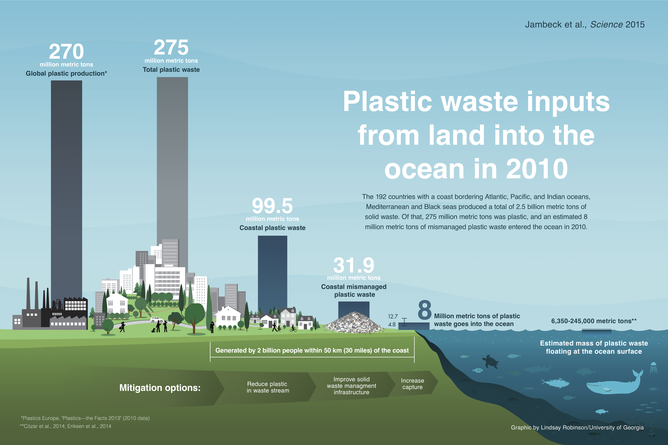
We all know it is a huge problem on a scale with Global warming but this one produces very little attention.
The simplest and most effective solution might be to make the plastic worth money. Deposits on beverage containers for instance, have proven effective at reducing waste lost into the environment – because the containers, plastic and otherwise, are worth money people don’t throw them away, or if they do others pick them up.
Extending this idea to a deposit on all plastics at the beginning of their lifecycle, as raw materials, would incentivize collection by formal waste managers where infrastructure is available, but also by consumers and entrepreneurs seeking income where it is not.
Before the plastic revolution, much of our waste was collected and burned. But the ubiquity, volume, and permanence of plastic waste demands better solutions.


Discussion · No Comments
There are no responses to "Eight million tonnes of plastic are going into the ocean each year". Comments are closed for this post.Oops! Sorry, comments are closed at this time. Please try again later.