


 How many people today grab a takeaway coffee cup from the local cafe to drink on the go? We don’t know, but the number must be enormous.. Most every one of the above have a plastic top that will last 100s of years. Some cafes still use plastic cups that last a similar time. Is 10 minutes of coffee worth 100s of years of trash?
These items can be seen littering our gutters and on our streets all over the place. If they were all cardboard, they would still be littered, but they would, at least, be gone in a short time.
They do not need to be made of plastic.
How many people today grab a takeaway coffee cup from the local cafe to drink on the go? We don’t know, but the number must be enormous.. Most every one of the above have a plastic top that will last 100s of years. Some cafes still use plastic cups that last a similar time. Is 10 minutes of coffee worth 100s of years of trash?
These items can be seen littering our gutters and on our streets all over the place. If they were all cardboard, they would still be littered, but they would, at least, be gone in a short time.
They do not need to be made of plastic.
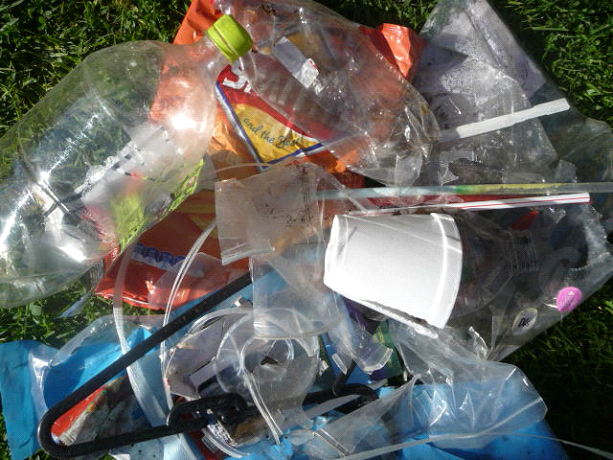 On the way home from the gym last week, a distance of about 1 km (1/2 mile), I counted the items of plastic litter on the curb as I walked. In that short distance I counted 63 pieces of plastic litter. Plastic drink bottles, bottle tops, candy wrappers, plastic film, polystyrene fragments etc. That seemed to be a lot to me. I guess it is a generational thing. Our parents would have been horrified to see that amount, whereas it seems to go unnoticed by our youth of today. In another 20 years how many pieces will there be on this stretch, -- 200? What will today’s youth think of that new amount then when they are older? Will their children be so readily accepting of a higher amount of litter?
 In Net zero targets and landfill methane emissions in the June/July issue of Inside Waste, Sam Bateman argues that landfills are net carbon sinks and better than Energy from Waste (EfW) from a Greenhouse Gas (GHG) perspective.
I wish landfills were net carbon sinks that we could rely on to store organics. It would solve many challenges, but it is just not true. The word ‘net’ gives the impression that they sequester more than they release. The problem is landfills are significant GHG emitters. They sequester some carbon but not enough.
The maths tells us the same thing. Here is an example for those readers mathematically inclined:
Let’s imagine we landfill one tonne of green waste in a well-run landfill. Let’s also generously assume that only 50 per cent of this decomposes over 1000 years. That means 50 per cent is sequestered (carbon sink) and 50 per cent decomposes anaerobically to form methane. Let’s further assume 75 per cent of the methane is captured over the life of the landfill and burnt to CO2. This again is very generous, as even Sam does not claim 75 per cent capture rates over the whole of life of a landfill. The best science from the US EPA and leading landfill gas experts says that it is 50 per cent over the whole life of the landfill. So, 12.5 per cent (50 per cent x 25 per cent) of the carbon atoms from that one tonne of green waste are now being fugitively emitted as methane. But methane has a 28 times higher Global Warming Potential (GWP) than carbon dioxide. In other words, methane stays in the atmosphere and reradiates heat far more effectively than carbon dioxide. That 12.5 per cent of methane causes 28 times the damage that would have occurred if that green waste had not been landfilled, i.e., allowed to naturally aerobically decompose or be aerobically composted. The key point is that landfills are anaerobic environments that generate methane not carbon dioxide. Methane is a far more potent greenhouse gas.
The result of landfilling our one tonne in a well-run landfill, in terms of the heating effect on the planet is 3.5 times higher (12.5 per cent x 28) than if the green waste had been composted or left to decompose in your garden, or burnt in an EfW. Methane is even more carbon forcing over short time frames. It is 80x over 20 years.


Discussion · No Comments
There are no responses to "". Comments are closed for this post.Oops! Sorry, comments are closed at this time. Please try again later.