


 How many people today grab a takeaway coffee cup from the local cafe to drink on the go? We don’t know, but the number must be enormous.. Most every one of the above have a plastic top that will last 100s of years. Some cafes still use plastic cups that last a similar time. Is 10 minutes of coffee worth 100s of years of trash?
These items can be seen littering our gutters and on our streets all over the place. If they were all cardboard, they would still be littered, but they would, at least, be gone in a short time.
They do not need to be made of plastic.
How many people today grab a takeaway coffee cup from the local cafe to drink on the go? We don’t know, but the number must be enormous.. Most every one of the above have a plastic top that will last 100s of years. Some cafes still use plastic cups that last a similar time. Is 10 minutes of coffee worth 100s of years of trash?
These items can be seen littering our gutters and on our streets all over the place. If they were all cardboard, they would still be littered, but they would, at least, be gone in a short time.
They do not need to be made of plastic.
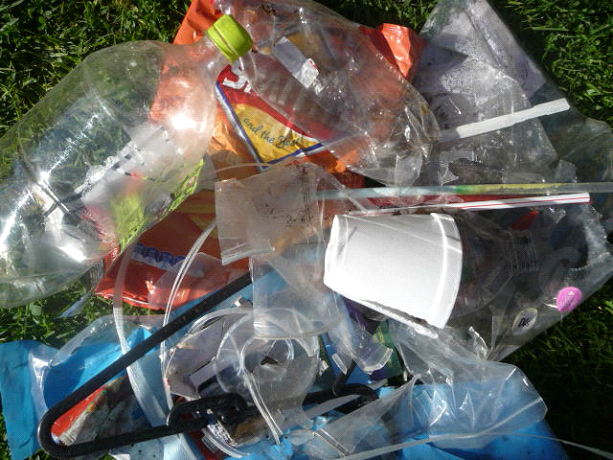 On the way home from the gym last week, a distance of about 1 km (1/2 mile), I counted the items of plastic litter on the curb as I walked. In that short distance I counted 63 pieces of plastic litter. Plastic drink bottles, bottle tops, candy wrappers, plastic film, polystyrene fragments etc. That seemed to be a lot to me. I guess it is a generational thing. Our parents would have been horrified to see that amount, whereas it seems to go unnoticed by our youth of today. In another 20 years how many pieces will there be on this stretch, -- 200? What will today’s youth think of that new amount then when they are older? Will their children be so readily accepting of a higher amount of litter?
 Concerns over microplastics in the food chain – Australia
Posted on October 12, 2014 by DrRossH in Plastic Waste NewsConcerns over microplastics in the food chain | SBS News.
The so-called micro plastics are increasingly making their way into water supplies, sparking concerns they may travel up the foodchain to humans.
It’s hard to complete your grocery shopping these days without purchasing them.
Plastic beads are found in exfoliating body washes, facial scrubs, washing detergent and even some toilet cleaners.
University of New South Wales PhD candidate Vivian Sim has been studying the prevalence of microplastics in the Sydney Harbour and says even she struggles to find products free of the pollutants.
“When I started this research I spent three hours in the supermarket trying to find products to replace all the current products I had that had microplastics and it’s pretty much near impossible.”
Microplastics are fragments of plastic less than five millimetres long.
If there ever was a list of recipes for disaster, these microplastics have to be very near the top. They don’t biodegrade, they get eaten by wildlife with no nourishment effect only a stomach clogging effect, they adsorb toxins…..
And the government ask manufacturers to ‘voluntarily’ limit their use. What a abdication of responsibility that is.


Discussion · No Comments
There are no responses to "Concerns over microplastics in the food chain – Australia". Comments are closed for this post.Oops! Sorry, comments are closed at this time. Please try again later.