


 How many people today grab a takeaway coffee cup from the local cafe to drink on the go? We don’t know, but the number must be enormous.. Most every one of the above have a plastic top that will last 100s of years. Some cafes still use plastic cups that last a similar time. Is 10 minutes of coffee worth 100s of years of trash?
These items can be seen littering our gutters and on our streets all over the place. If they were all cardboard, they would still be littered, but they would, at least, be gone in a short time.
They do not need to be made of plastic.
How many people today grab a takeaway coffee cup from the local cafe to drink on the go? We don’t know, but the number must be enormous.. Most every one of the above have a plastic top that will last 100s of years. Some cafes still use plastic cups that last a similar time. Is 10 minutes of coffee worth 100s of years of trash?
These items can be seen littering our gutters and on our streets all over the place. If they were all cardboard, they would still be littered, but they would, at least, be gone in a short time.
They do not need to be made of plastic.
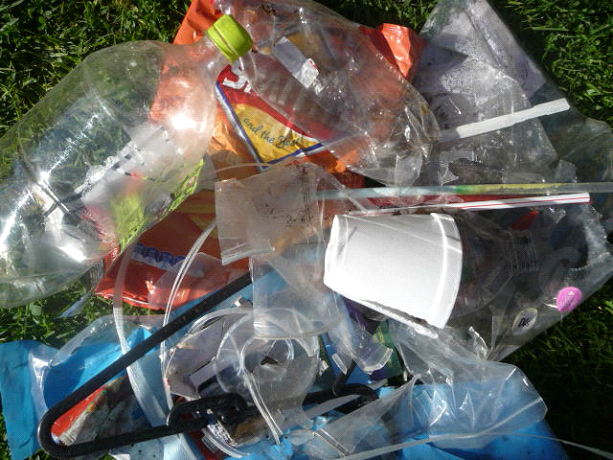 On the way home from the gym last week, a distance of about 1 km (1/2 mile), I counted the items of plastic litter on the curb as I walked. In that short distance I counted 63 pieces of plastic litter. Plastic drink bottles, bottle tops, candy wrappers, plastic film, polystyrene fragments etc. That seemed to be a lot to me. I guess it is a generational thing. Our parents would have been horrified to see that amount, whereas it seems to go unnoticed by our youth of today. In another 20 years how many pieces will there be on this stretch, -- 200? What will today’s youth think of that new amount then when they are older? Will their children be so readily accepting of a higher amount of litter?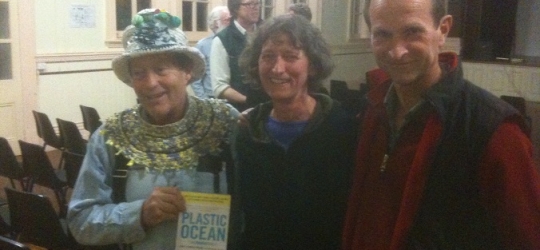
Our Plastic polluted oceans
Posted on September 26, 2012 by DrRossH in Plastic & Wildlife
Captain Charles Moore on Left with PWS
Last night we went to a presentation by Charles Moore, who is credited with discovering the plastic Pacific Garbage Patch. The region NE of Hawaii that has a higher concentration of plastic bits then the rest of the Pacific due to ocean currents leading to this region. Needless to say a very good presentation. His biggest problem item is the very small pellets from either plastic degradation or the raw batch pellets that are in the oceans and killing vast numbers of fish and birds with horrible deaths of
1) starvation, (them feeling full as their stomach is full of plastic but no nutrients and the larger pieces relative to the animal size, cannot pass through their intestines), or
2) suffocation, or
3) drowning as their buoyancy changes with the plastic in them and they can’t dive down, or
4) toxicity of consuming plastic that has accumulated toxins on to its surface as it floats around the ocean regions. While one little plankton may not die of toxin poisoning, it is their predator that eats 1000,000’s of them that has high toxin content and then that one’s predator who eats many of those ones and on up the food chain it goes to get to the top food eater, us.
On a scale of planet issues, he agrees with PWS, this plastic waste issue is more important than Climate Change as Climate Change is not killing off all this wildlife at the moment and the consequences are going to be with us just as long lasting.


Discussion · No Comments
There are no responses to "Our Plastic polluted oceans". Comments are closed for this post.Oops! Sorry, comments are closed at this time. Please try again later.