


 How many people today grab a takeaway coffee cup from the local cafe to drink on the go? We don’t know, but the number must be enormous.. Most every one of the above have a plastic top that will last 100s of years. Some cafes still use plastic cups that last a similar time. Is 10 minutes of coffee worth 100s of years of trash?
These items can be seen littering our gutters and on our streets all over the place. If they were all cardboard, they would still be littered, but they would, at least, be gone in a short time.
They do not need to be made of plastic.
How many people today grab a takeaway coffee cup from the local cafe to drink on the go? We don’t know, but the number must be enormous.. Most every one of the above have a plastic top that will last 100s of years. Some cafes still use plastic cups that last a similar time. Is 10 minutes of coffee worth 100s of years of trash?
These items can be seen littering our gutters and on our streets all over the place. If they were all cardboard, they would still be littered, but they would, at least, be gone in a short time.
They do not need to be made of plastic.
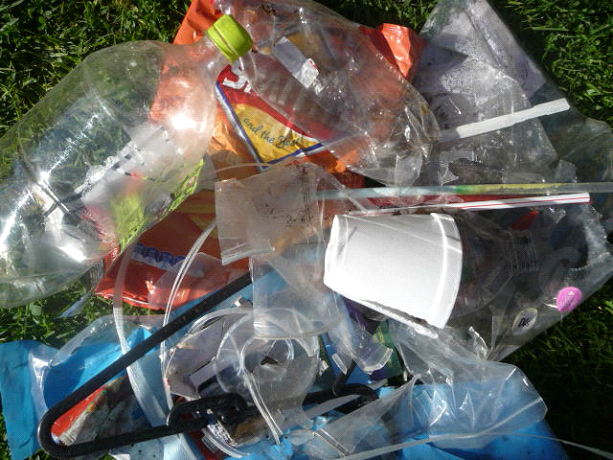 On the way home from the gym last week, a distance of about 1 km (1/2 mile), I counted the items of plastic litter on the curb as I walked. In that short distance I counted 63 pieces of plastic litter. Plastic drink bottles, bottle tops, candy wrappers, plastic film, polystyrene fragments etc. That seemed to be a lot to me. I guess it is a generational thing. Our parents would have been horrified to see that amount, whereas it seems to go unnoticed by our youth of today. In another 20 years how many pieces will there be on this stretch, -- 200? What will today’s youth think of that new amount then when they are older? Will their children be so readily accepting of a higher amount of litter?
 Symphony urges manufacturers to turn to oxo biodegradables – UK
Posted on November 3, 2013 by DrRossH in Plastic Waste NewsUK-based Symphony Environmental Technologies plc says manufacturers should use oxo degradable additives because bio-based materials are expensive, hard to recycle and don’t have the same qualities as traditional materials.
According to Laurier, bio-based materials are expensive and don’t have the same qualities as non bio alternatives. He also pointed out that bio-based solutions don’t solve the problem of plastic litter.
Earlier this year industry association EuPC slammed oxo fragmentable plastics, saying they should be banned in Europe
Symphony always try to steer the conversation to what they propose their product will do and not to talk about the weaknesses of their product. For example in this article they try to compare their product in conventional plastics to biobased plastics. They are right that biobased plastics are expensive. They also say their product is good for litter. At PWS we have a problem with this. Their additive causes plastics to fragment into little bite size pieces of plastic that blow and flow around the environment. Wildlife are prone then to eat them and choke on them. Their product causes a slow chemical reaction that only works when plastic is left out in the open where the air (oxygen) and sunlight can get to it. A plastic with their oxo additive in it cannot be mainstream recycled as the new product could them fragment too.
A better solution for plastic waste is to use a landfill-biodegradable additive that allows a plastic to biodegrade in an environment where microorganisms are present such as a landfill. With these additives in them, plastics can also be main stream recycled, will not break down on the shelf like an oxo does, and will not fragment into dangerous bite size pieces. Biodegradation can lead to landfill gas capture for energy production, where as an oxo plastic loses that ability. See www.ensoplastics.com for an example of a landfill-biodegradable additive.


Discussion · No Comments
There are no responses to "Symphony urges manufacturers to turn to oxo biodegradables – UK". Comments are closed for this post.Oops! Sorry, comments are closed at this time. Please try again later.