


 How many people today grab a takeaway coffee cup from the local cafe to drink on the go? We don’t know, but the number must be enormous.. Most every one of the above have a plastic top that will last 100s of years. Some cafes still use plastic cups that last a similar time. Is 10 minutes of coffee worth 100s of years of trash?
These items can be seen littering our gutters and on our streets all over the place. If they were all cardboard, they would still be littered, but they would, at least, be gone in a short time.
They do not need to be made of plastic.
How many people today grab a takeaway coffee cup from the local cafe to drink on the go? We don’t know, but the number must be enormous.. Most every one of the above have a plastic top that will last 100s of years. Some cafes still use plastic cups that last a similar time. Is 10 minutes of coffee worth 100s of years of trash?
These items can be seen littering our gutters and on our streets all over the place. If they were all cardboard, they would still be littered, but they would, at least, be gone in a short time.
They do not need to be made of plastic.
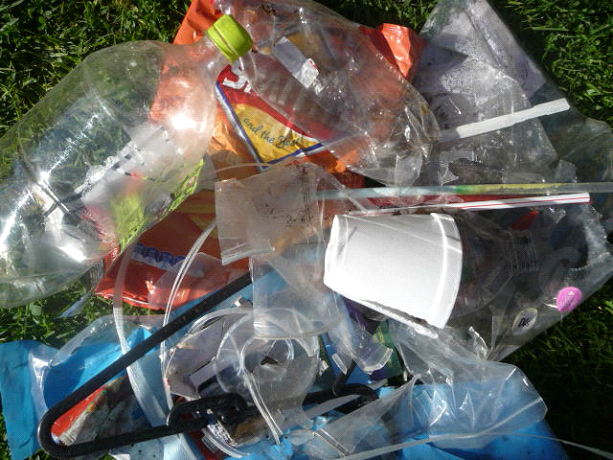 On the way home from the gym last week, a distance of about 1 km (1/2 mile), I counted the items of plastic litter on the curb as I walked. In that short distance I counted 63 pieces of plastic litter. Plastic drink bottles, bottle tops, candy wrappers, plastic film, polystyrene fragments etc. That seemed to be a lot to me. I guess it is a generational thing. Our parents would have been horrified to see that amount, whereas it seems to go unnoticed by our youth of today. In another 20 years how many pieces will there be on this stretch, -- 200? What will today’s youth think of that new amount then when they are older? Will their children be so readily accepting of a higher amount of litter?
 Where does your recycling go? The answer may surprise you
Posted on January 17, 2017 by DrRossH in Plastic Waste NewsWhile U.S. and Canadian industry buys some of the paper and most of the cast-off factory steel, much of the rest — especially plastics — ends up on barges to the developing world.
Source: Where does your recycling go? The answer may surprise you
I’m always a little irritated when I hear people say “recycling is good for the environment.” It still takes a resource toll.
I hate, I absolutely hate, the image of the three arrows making a triangle. Paper can be recycled six or seven times. Most plastics can only be “down-cycled.” Down-cycling means that you are taking something that had a use and basically lowering the use value — for example, plastic candy wrappers can’t be recycled into new candy wrappers. You melt them down and you get a very ugly hard plastic. Who would want that plastic? Somebody making something really cheap, like plastic lumber. You lose the flexibility to use that product in a variety of ways. Even metals, whenever you melt down metals in the smelting process, there’s always material lost along the way. It’s not a closed loop. There will never be a closed loop.
Great article. Every one who thinks recycling is the be all to end all ought to read this.


Discussion · No Comments
There are no responses to "Where does your recycling go? The answer may surprise you". Comments are closed for this post.Oops! Sorry, comments are closed at this time. Please try again later.