


 How many people today grab a takeaway coffee cup from the local cafe to drink on the go? We don’t know, but the number must be enormous.. Most every one of the above have a plastic top that will last 100s of years. Some cafes still use plastic cups that last a similar time. Is 10 minutes of coffee worth 100s of years of trash?
These items can be seen littering our gutters and on our streets all over the place. If they were all cardboard, they would still be littered, but they would, at least, be gone in a short time.
They do not need to be made of plastic.
How many people today grab a takeaway coffee cup from the local cafe to drink on the go? We don’t know, but the number must be enormous.. Most every one of the above have a plastic top that will last 100s of years. Some cafes still use plastic cups that last a similar time. Is 10 minutes of coffee worth 100s of years of trash?
These items can be seen littering our gutters and on our streets all over the place. If they were all cardboard, they would still be littered, but they would, at least, be gone in a short time.
They do not need to be made of plastic.
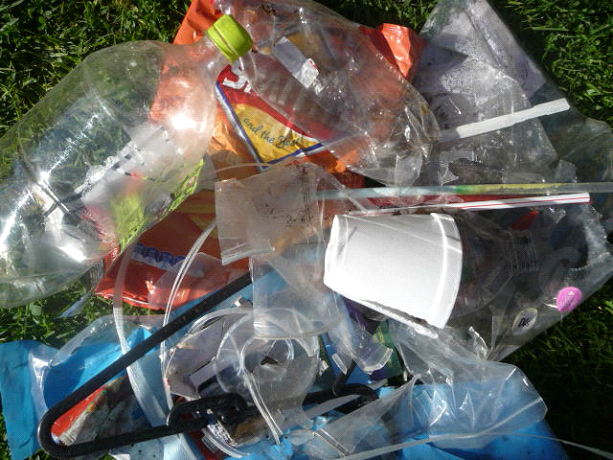 On the way home from the gym last week, a distance of about 1 km (1/2 mile), I counted the items of plastic litter on the curb as I walked. In that short distance I counted 63 pieces of plastic litter. Plastic drink bottles, bottle tops, candy wrappers, plastic film, polystyrene fragments etc. That seemed to be a lot to me. I guess it is a generational thing. Our parents would have been horrified to see that amount, whereas it seems to go unnoticed by our youth of today. In another 20 years how many pieces will there be on this stretch, -- 200? What will today’s youth think of that new amount then when they are older? Will their children be so readily accepting of a higher amount of litter?
 June 2015 - Plastic Waste Solutions
-
World Plastics Council supports G7 leaders marine plan | Plastics News#utm_medium=email&utm_source=pn-sustain&utm_campaign=pn-sustain-20150618&email_sustain#utm_medium=email&utm_source=pn-sustain&utm_campaign=pn-sustain-20150618&email_sustain
Posted on June 18, 2015 by DrRossH in Plastic Waste NewsWorld Plastics Council supports G7 leaders marine plan | Plastics News#utm_medium=email&utm_source=pn-sustain&utm_campaign=pn-sustain-20150618&email_sustain#utm_medium=email&utm_source=pn-sustain&utm_campaign=pn-sustain-20150618&email_sustain. The World Plastics Council has welcomed news that leaders of the G7 group of countries laid out a “bold action plan” to cut marine litter while at the recent...
Continue reading this entry → -
NSW Premier Mike Baird announces 2017 start date for cash for cans- Australia
Posted on June 18, 2015 by DrRossH in Plastic Limiting RegulationsNSW Premier Mike Baird announces 2017 start date for cash for cans. NSW residents will be rewarded for collecting and returning bottles and cans to hundreds of reverse vending machines across NSW from July 2017, Premier Mike Baird will announce...
Continue reading this entry → -
Italy Clarifies Plastic Bag Law, Enforcement Starts in May
Posted on June 17, 2015 by DrRossH in Plastic Limiting Regulations– Italy Clarifies Plastic Bag Law, Enforcement Starts in May | ENS. A year after passing a nationwide plastic bag ban, the Italian government has identified the technical characteristics of plastic bags that can legally be used in a decree...
Continue reading this entry → -
DIRECTIVE (EU) 2015/720 OF THE EUROPEAN PARLIAMENT as regards reducing the consumption of lightweight plastic carrier bags
Posted on June 8, 2015 by DrRossH in Plastic Limiting RegulationsEUR-Lex - 32015L0720 - EN - EUR-Lex. Item 18 Some plastic carrier bags are marked as ‘oxo-biodegradable’ or ‘oxo-degradable’ by their manufacturers. In such bags, additives are incorporated into conventional plastics. Due to the presence of those additives, the plastic...
Continue reading this entry → -
Major US cities phasing out PS foam school lunch trays – USA
Posted on June 5, 2015 by DrRossH in Plastic Waste NewsMajor US cities phasing out PS foam school lunch trays | Plastics News#utm_medium=email&utm_source=pn-sustain&utm_campaign=pn-sustain-20150604&email_sustain. Polystyrene foam trays will be swapped out for compostable plates at schools in New York, Los Angeles, Chicago, Dallas, Miami and Orlando, Fla., next year. The change...
Continue reading this entry → -
‘Biodegradable’ plastics don’t live up to manufacturers’ claims – USA
Posted on June 3, 2015 by DrRossH in Plastic Waste News'Biodegradable' plastics don't live up to manufacturers' claims – News – ABC Environment #Australian Broadcasting Corporation#. BIN LINERS and other products made of 'biodegradable' plastic may not living up to their claims, according to new US research. In response to consumer...
Continue reading this entry → -
Evaluation of Biodegradation-Promoting Additives for Plastics – Environmental Science & Technology
Posted on June 2, 2015 by DrRossH in Plastic Waste NewsEvaluation of Biodegradation-Promoting Additives for Plastics - Environmental Science & Technology (ACS Publications). Biodegradation-promoting additives for polymers are increasingly being used around the world with the claim that they effectively render commercial polymers biodegradable. However, there is a lot of...
Continue reading this entry →