


 How many people today grab a takeaway coffee cup from the local cafe to drink on the go? We don’t know, but the number must be enormous.. Most every one of the above have a plastic top that will last 100s of years. Some cafes still use plastic cups that last a similar time. Is 10 minutes of coffee worth 100s of years of trash?
These items can be seen littering our gutters and on our streets all over the place. If they were all cardboard, they would still be littered, but they would, at least, be gone in a short time.
They do not need to be made of plastic.
How many people today grab a takeaway coffee cup from the local cafe to drink on the go? We don’t know, but the number must be enormous.. Most every one of the above have a plastic top that will last 100s of years. Some cafes still use plastic cups that last a similar time. Is 10 minutes of coffee worth 100s of years of trash?
These items can be seen littering our gutters and on our streets all over the place. If they were all cardboard, they would still be littered, but they would, at least, be gone in a short time.
They do not need to be made of plastic.
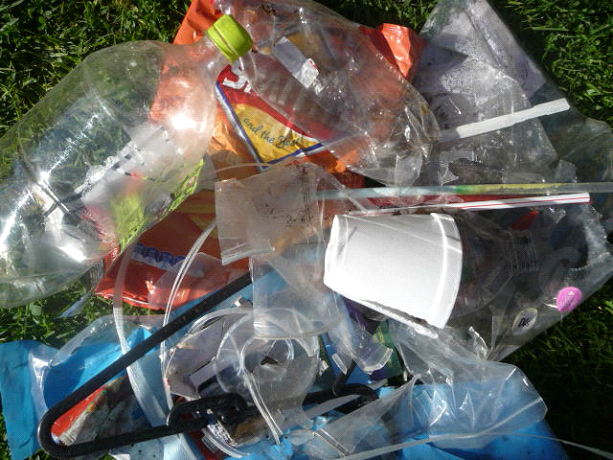 On the way home from the gym last week, a distance of about 1 km (1/2 mile), I counted the items of plastic litter on the curb as I walked. In that short distance I counted 63 pieces of plastic litter. Plastic drink bottles, bottle tops, candy wrappers, plastic film, polystyrene fragments etc. That seemed to be a lot to me. I guess it is a generational thing. Our parents would have been horrified to see that amount, whereas it seems to go unnoticed by our youth of today. In another 20 years how many pieces will there be on this stretch, -- 200? What will today’s youth think of that new amount then when they are older? Will their children be so readily accepting of a higher amount of litter?
 Less than 2% of degradable bags can cause detriment to carrier bag recycling, study shows
Posted on December 10, 2013 by DrRossH in Plastic Waste NewsLess than 2% of biodegradable bags can cause detriment to carrier bag recycling, study shows.
This article reflects most of the misunderstandings of the use of the word biodegradable. It starts off talking about biodegradable plastics then goes on to discuss degradable plastics as though they were the same thing. They are not and this needs to be made clear to the industry. Manufacturers like EPI uses dubious terms to infer the degradable product is biodegradable which it is not.
Degradable plastics are plastics with an additive that undergoes a slow chemical reaction to cause the plastic to fragment into 1000′s of little bits of plastic. This is an environmental problem.
Biodegradable plastics are made from two different methods too. 1) Landfill-Biodegradable plastics on the other hand undergo a biological process when they are exposed to micro-organisms. This is an ideal situation and very beneficial for the environment. 2) Compostable biodegradable plastics are made from bio sources. These cannot be landfilled as they do not biodegrade due to lack of oxygen or too low of temperatures in a landfill. These cannot be mainstream recycled either, but have to be collected separately and sent to a special commercial compost facility.
The author of this article needs to be careful in how they write biodegradable and degradable. Yes degradable plastics would need their own collection stream so as they do not contaminate main stream recyclate. If there is to be separate stream recycling of degradable plastics then they will either be landfilled (where they will not biodegrade or even degrade due to lack of oxygen) or they will be incinerated in a WTE plant. Both of which begs the question of why put the degradable additive in the plastic in the first place then?
On the other hand plastics made landfill-biodegradable can be main stream recycled as they do not impact the plastic till it is disposed to an environment with microorganisms present. Compostable biodegradable plastics do need their own separate recycling stream which makes them impractical to use at the consumer level.


Discussion · No Comments
There are no responses to "Less than 2% of degradable bags can cause detriment to carrier bag recycling, study shows". Comments are closed for this post.Oops! Sorry, comments are closed at this time. Please try again later.