


 How many people today grab a takeaway coffee cup from the local cafe to drink on the go? We don’t know, but the number must be enormous.. Most every one of the above have a plastic top that will last 100s of years. Some cafes still use plastic cups that last a similar time. Is 10 minutes of coffee worth 100s of years of trash?
These items can be seen littering our gutters and on our streets all over the place. If they were all cardboard, they would still be littered, but they would, at least, be gone in a short time.
They do not need to be made of plastic.
How many people today grab a takeaway coffee cup from the local cafe to drink on the go? We don’t know, but the number must be enormous.. Most every one of the above have a plastic top that will last 100s of years. Some cafes still use plastic cups that last a similar time. Is 10 minutes of coffee worth 100s of years of trash?
These items can be seen littering our gutters and on our streets all over the place. If they were all cardboard, they would still be littered, but they would, at least, be gone in a short time.
They do not need to be made of plastic.
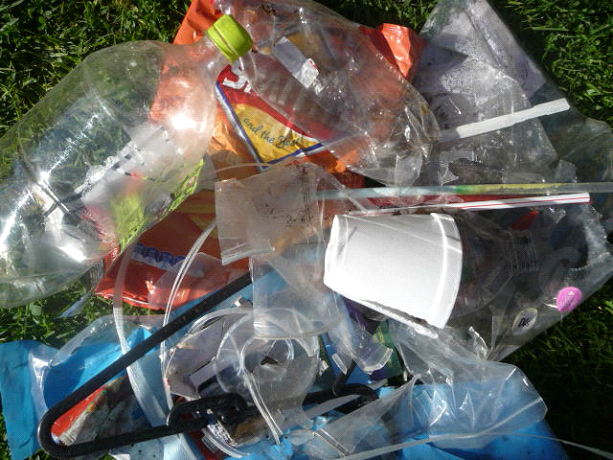 On the way home from the gym last week, a distance of about 1 km (1/2 mile), I counted the items of plastic litter on the curb as I walked. In that short distance I counted 63 pieces of plastic litter. Plastic drink bottles, bottle tops, candy wrappers, plastic film, polystyrene fragments etc. That seemed to be a lot to me. I guess it is a generational thing. Our parents would have been horrified to see that amount, whereas it seems to go unnoticed by our youth of today. In another 20 years how many pieces will there be on this stretch, -- 200? What will today’s youth think of that new amount then when they are older? Will their children be so readily accepting of a higher amount of litter?
 Methane Emissions Concerns for Compostable Plastics?
Posted on July 7, 2011 by DrRossH in Plastic Waste NewsResearch and articles about biodegradable plastics releasing methane too quickly in landfills have been taking over the internet this past June. An alarming title to draw readers in, splashed on a article/blog written with bits of information that have trickled down from a once reliable source. Is biodegradable really harmful??
The original research was performed using “compostable plastics” designed to break down in as fast as 180 days! ENSO Plastics are not “compostable plastics”.
ENSO is a global company and recognizes that some people aren’t as far ahead in methane-friendly landfill technology as North America (Environmental Protection Agency’s Landfill Methane Program at http://www.epa.gov/lmop ). The fact is that even banana peels and apple cores release methane in a landfill as a natural byproduct of biodegradation.
Common sense says that truly “Earth Friendly Plastics” are not in a race to biodegrade as quickly as possible for many reasons. ENSO Plastics are engineered to biodegrade in a controlled manner; between 5 and 15 years in real-world landfill conditions. This strikes a wonderful balance between a manageable release of naturally occurring biogases and the timely breakdown of plastic waste in a landfill. Just another example as to why ENSO is the answer to today’s plastic problem.
Note by DrRossH. ENSO use a landfill biodegradable additive to make their products biodegradable.


Discussion · No Comments
There are no responses to "Methane Emissions Concerns for Compostable Plastics?". Comments are closed for this post.Oops! Sorry, comments are closed at this time. Please try again later.