


 How many people today grab a takeaway coffee cup from the local cafe to drink on the go? We don’t know, but the number must be enormous.. Most every one of the above have a plastic top that will last 100s of years. Some cafes still use plastic cups that last a similar time. Is 10 minutes of coffee worth 100s of years of trash?
These items can be seen littering our gutters and on our streets all over the place. If they were all cardboard, they would still be littered, but they would, at least, be gone in a short time.
They do not need to be made of plastic.
How many people today grab a takeaway coffee cup from the local cafe to drink on the go? We don’t know, but the number must be enormous.. Most every one of the above have a plastic top that will last 100s of years. Some cafes still use plastic cups that last a similar time. Is 10 minutes of coffee worth 100s of years of trash?
These items can be seen littering our gutters and on our streets all over the place. If they were all cardboard, they would still be littered, but they would, at least, be gone in a short time.
They do not need to be made of plastic.
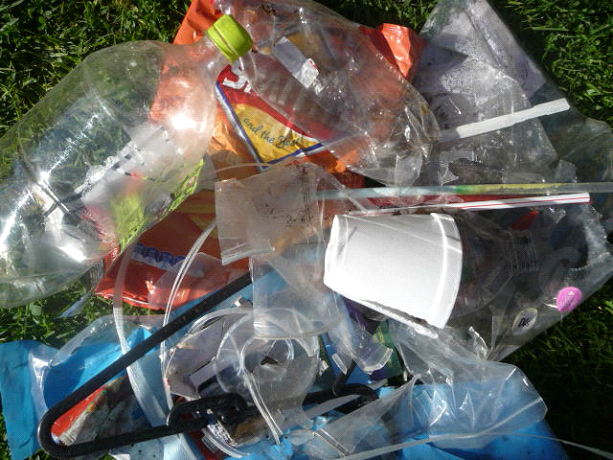 On the way home from the gym last week, a distance of about 1 km (1/2 mile), I counted the items of plastic litter on the curb as I walked. In that short distance I counted 63 pieces of plastic litter. Plastic drink bottles, bottle tops, candy wrappers, plastic film, polystyrene fragments etc. That seemed to be a lot to me. I guess it is a generational thing. Our parents would have been horrified to see that amount, whereas it seems to go unnoticed by our youth of today. In another 20 years how many pieces will there be on this stretch, -- 200? What will today’s youth think of that new amount then when they are older? Will their children be so readily accepting of a higher amount of litter?
 Researchers are on the hunt to find a more environmentally friendly alternative to conventional plastic – USA
Posted on August 16, 2015 by DrRossH in BioPlastics, Plastic Waste News“We’ve seen this huge increase in production in plastic that results in an increase in the waste stream as well,” says Jenna Jambeck, an environmental engineering faculty member at the University of Georgia. “Unlike material that biodegrades, plastic has all of these issues. It easily travels into waterways, it physically fragments into smaller pieces which are extremely hard or impossible to collect, and [it tends to] absorb chemical contaminants that are already in the environment.”
Some 5.3 million to 14 million tons of plastic, or up to 4 percent of the roughly 330 million tons of plastic produced each year, entered the ocean as trash in 2010. The figure is expected to increase 10-fold in the next decade as more plastic is produced and subsequently evades waste management and recycling efforts, according to a study Jambeck and colleagues published earlier this year in the journal Science.
What effect all this plastic has on living things, including humans, remains unclear. A number of recent studies show that chemicals in small bits of plastic, and even the plastic bits themselves, can accumulate in birds, fish and other marine life. Laboratory testing has shown the chemicals that comprise them can cause adverse health effects, including liver damage and endocrine disruption through altered gene expression. Whether similar effects occur outside the laboratory or whether they extend up the food chain to people who eat marine organisms remains unknown, yet both seem entirely plausible.
And that’s not all. Plastics are notorious in the greenhouse gas department as well. Roughly 8 percent of the petroleum used worldwide each year goes to make plastic directly or to power the plastic manufacturing processes, according to a recent report by the Worldwatch Institute.


Discussion · No Comments
There are no responses to "Researchers are on the hunt to find a more environmentally friendly alternative to conventional plastic – USA". Comments are closed for this post.Oops! Sorry, comments are closed at this time. Please try again later.