


 How many people today grab a takeaway coffee cup from the local cafe to drink on the go? We don’t know, but the number must be enormous.. Most every one of the above have a plastic top that will last 100s of years. Some cafes still use plastic cups that last a similar time. Is 10 minutes of coffee worth 100s of years of trash?
These items can be seen littering our gutters and on our streets all over the place. If they were all cardboard, they would still be littered, but they would, at least, be gone in a short time.
They do not need to be made of plastic.
How many people today grab a takeaway coffee cup from the local cafe to drink on the go? We don’t know, but the number must be enormous.. Most every one of the above have a plastic top that will last 100s of years. Some cafes still use plastic cups that last a similar time. Is 10 minutes of coffee worth 100s of years of trash?
These items can be seen littering our gutters and on our streets all over the place. If they were all cardboard, they would still be littered, but they would, at least, be gone in a short time.
They do not need to be made of plastic.
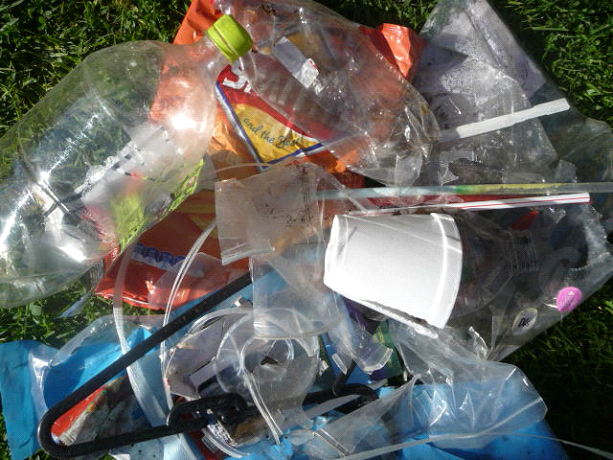 On the way home from the gym last week, a distance of about 1 km (1/2 mile), I counted the items of plastic litter on the curb as I walked. In that short distance I counted 63 pieces of plastic litter. Plastic drink bottles, bottle tops, candy wrappers, plastic film, polystyrene fragments etc. That seemed to be a lot to me. I guess it is a generational thing. Our parents would have been horrified to see that amount, whereas it seems to go unnoticed by our youth of today. In another 20 years how many pieces will there be on this stretch, -- 200? What will today’s youth think of that new amount then when they are older? Will their children be so readily accepting of a higher amount of litter?
 Why should plastics degrade in landfills?
Posted on July 13, 2011 by DrRossH in Plastic Waste NewsReply from Teresa Clarke of Enso. It seems the question was the long term and short term usefulness of biodegradable plastics in landfills. Are they beneficial? Should we only use compostable and avoid the landfill altogether? Why would we want products to biodegrade in the landfill?
The answer is, It depends.
We need to address our waste. The adage of burying and ignoring the problem does not make it go away. It causes additional problems of toxic leachate, methane leaching, ground-water-air pollution and uncontrolled methane production. In this type of scenario, there is not a huge advantage to having any of the material, including plastics, biodegrade.
Luckily, we have advanced as a society in most cultures beyond this and are seeing trash as a value. We design landfills to control biodegradation, enhance biodegradation and harness the energy from the production of methane. With modern landfills such as this, it is most beneficial to have all the materials biodegrade – even plastics. One key however is to have biodegradation happen between 2-20 years so that it is during the active management of the landfill. Biodegrade too quickly and the potential for utilizing the energy of methane is lost, biodegrade too slowly and the methane is lost as well.
Composting on the other hand is a quick controlled process that although seems ideal, is not the best choice. Composting creates carbon dioxide instead of methane. We cannot combust the CO2 and capture the energy. With landfilling and anaerobic digesters we can harness the energy and still have the same CO2 byproduct. I can share a study that compares the environmental impact of composting vs anaerobic digesting – in short, compost did not win.
So in today’s waste disposal landfill biodegradable is a huge benefit. Reduced land space, energy recovery, non-toxic byproducts are all part of the calculation. Ultimately, we need biodegradable (not compostable) plastics that are made from renewable sourcing so that the CO2 released does not add to the overall CO2 levels of our air – however that is a sourcing issue and not the end of life issue we are discussing here.
BTW – all plastics will biodegrade over 100’s of years causing uncontrolled release of methane. Why would we not want to speed up the process so we can harness that energy?


Discussion · No Comments
There are no responses to "Why should plastics degrade in landfills?". Comments are closed for this post.Oops! Sorry, comments are closed at this time. Please try again later.